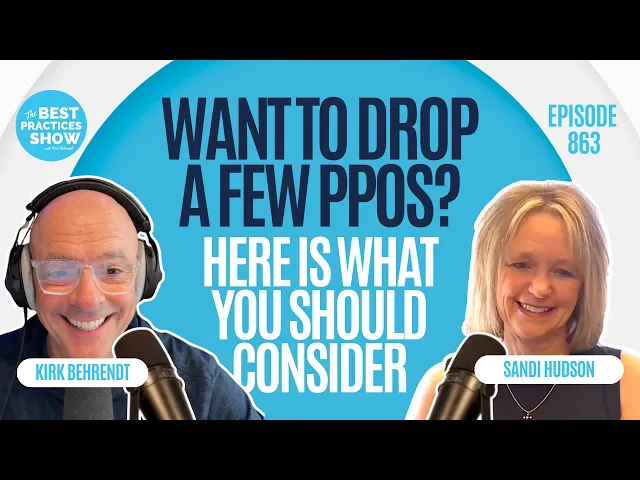
Watch our discussion on YouTube
Listen to our discussion on Spotify
Summary
Managing PPO participation has become one of the most complex—and misunderstood—parts of running a dental practice. In this episode, Unlock the PPO founder Sandi Hudson joins Kirk Behrendt for an in-depth discussion on how PPOs have evolved, why so many practices feel overwhelmed, and what dentists can do to regain clarity and control.
Rather than offering a one-size-fits-all solution, the conversation focuses on understanding today’s insurance landscape, identifying risks hidden inside shared network agreements, and aligning insurance decisions with the long-term direction of the practice.
PPOs Today vs. 10 Years Ago: What Changed?
One of the biggest shifts in dental insurance is the rise of shared network agreements. While PPO contracts once felt relatively straightforward, most insurance companies now participate in multiple overlapping networks. That means a single contract can quietly connect a practice to several other insurance plans—often without explicit consent.
Dentists are frequently opted in by default, with the responsibility falling on the practice to identify these relationships and opt out when they are not a good fit. This change has made passive contract management risky and has increased the need for regular review and oversight.
Why PPOs Feel Overwhelming (and Why It’s Not Just You)
A key theme throughout the conversation is reassurance: this is hard, and it’s hard for almost everyone.
Dentists weren’t trained to manage insurance contracts
Front office turnover after COVID disrupted continuity
Even insurance representatives face more layers and less authority than they used to
As a result, PPO management has effectively become its own specialty. Feeling confused or behind is not a failure—it’s a reflection of how much the system has changed.
Understanding Shared Network Agreements
Shared network agreements allow one insurance company to access another company’s fee schedule. While these arrangements aren’t automatically bad, they can significantly impact reimbursement if not fully understood.
Key considerations discussed include:
Which companies are attached to which fee schedules
Whether reimbursement follows the highest or lowest available path
The difference between terminating a contract and opting out of a shared agreement
Without clear awareness, practices may underestimate how much production is truly tied to a lower-paying fee schedule.
Why Auditing EOBs Is Non-Negotiable
One of the most actionable takeaways is the importance of monthly EOB audits. Reviewing explanations of benefits helps confirm:
Which fee schedule is being applied
Whether shared networks have been activated
If recent insurance notices resulted in payment changes
Insurance companies often communicate these changes through letters that seem minor or irrelevant at first. Missing or ignoring them can lead to reimbursement surprises months later.
Practice Direction Comes First—Not Insurance Decisions
A major part of the discussion centers on aligning PPO participation with the practice’s business model and goals.
Some practices prioritize:
Consistent patient flow with minimal marketing
Hygiene-driven growth
Others are moving toward:
Fewer patients with higher-value procedures
Reduced reliance on PPO volume
Neither approach is “right” or “wrong,” but insurance decisions should support—not contradict—the chosen direction.
When Dropping PPOs Makes Sense (and How to Do It Safely)
Rather than making sweeping changes, the episode emphasizes a measured, strategic approach:
Start by understanding your baseline
Identify low-impact contracts with minimal production
Test changes gradually before eliminating high-volume plans
This allows practices to reduce risk while learning how patients respond.
Booking Out, Associates, and Hidden Profit Leaks
Being booked out weeks in advance can feel reassuring—but it may also signal inefficiency. Filling schedules with lower-paying PPO patients can crowd out higher-value opportunities.
Before:
Building more operatories
Hiring an associate
It’s critical to evaluate whether current PPO reimbursement actually supports growth. Improving fee schedules first can dramatically change staffing and expansion decisions.
Why Fee-for-Service Dentistry Is Not Dead
Despite common fears, fee-for-service dentistry is very much alive. Many practices are successfully reducing PPO dependence—or eliminating it altogether—by:
Understanding their data
Making intentional, informed decisions
Communicating changes clearly with staff and patients
The shift requires planning, patience, and education—but it is far from impossible.
Final Encouragement for Dentists
The biggest message from this conversation is reassurance. Dentists are not failing at insurance management—the industry has changed beneath them. Contracts signed years ago no longer function the same way, and keeping up now requires far more attention than it once did.
With the right analysis, persistence, and support, practices can make insurance decisions that protect profitability, reduce stress, and align with their long-term vision.